
Urban Oasis

HOW A SHOPPING ARCADE BECOMES AN ECOSYSTEM

How can architecture be designed to actively support the climate – without replacing existing structures, but instead making sensible use of them?

This question has been on the mind of our colleague Philipp Eder throughout his bachelor’s thesis in architecture. When he’s not working with us on project support or tinkering with new features for SCALES, Philipp is actually studying architecture. And he runs marathons on the side, too. (We’ve no idea where he finds the time for that.)

The brief for his thesis

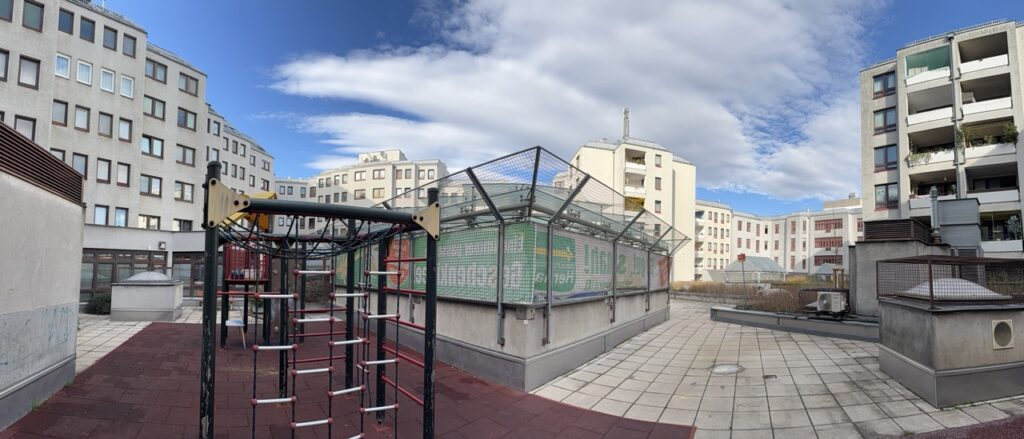
Revitalise a little-used shopping arcade in Vienna. The adjacent courtyard as well. And all this with a view to achieving a climate-related goal that goes beyond a conventional ventilation system. But Philipp wouldn’t be Philipp if he’d simply stuck to the task at hand.

His approach

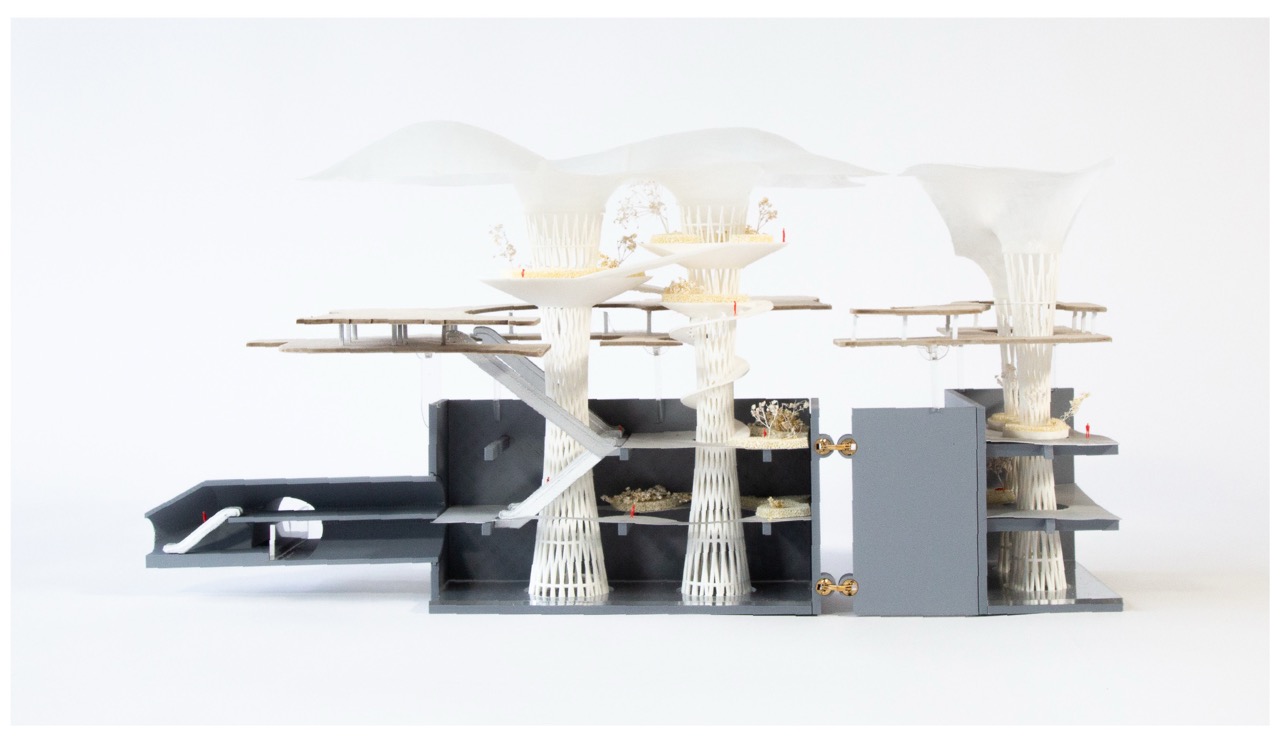
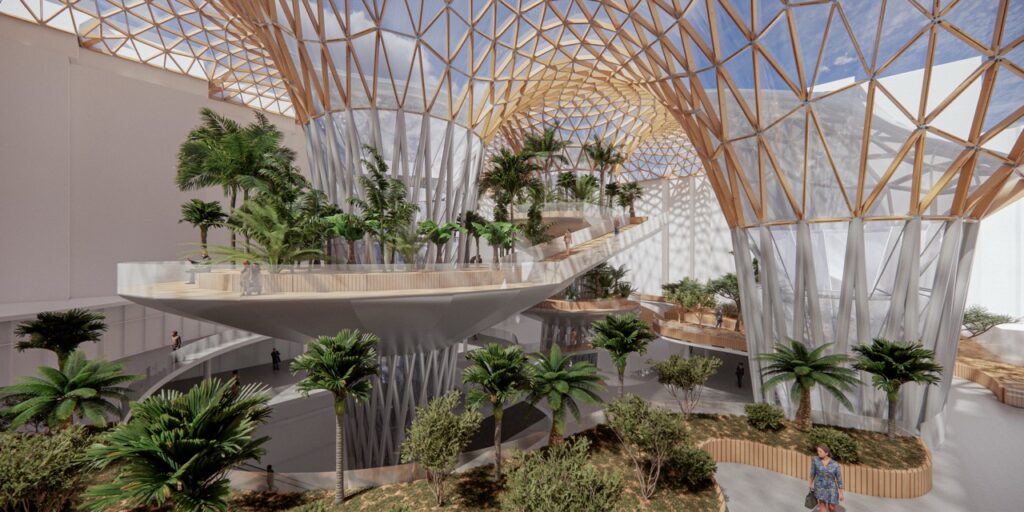
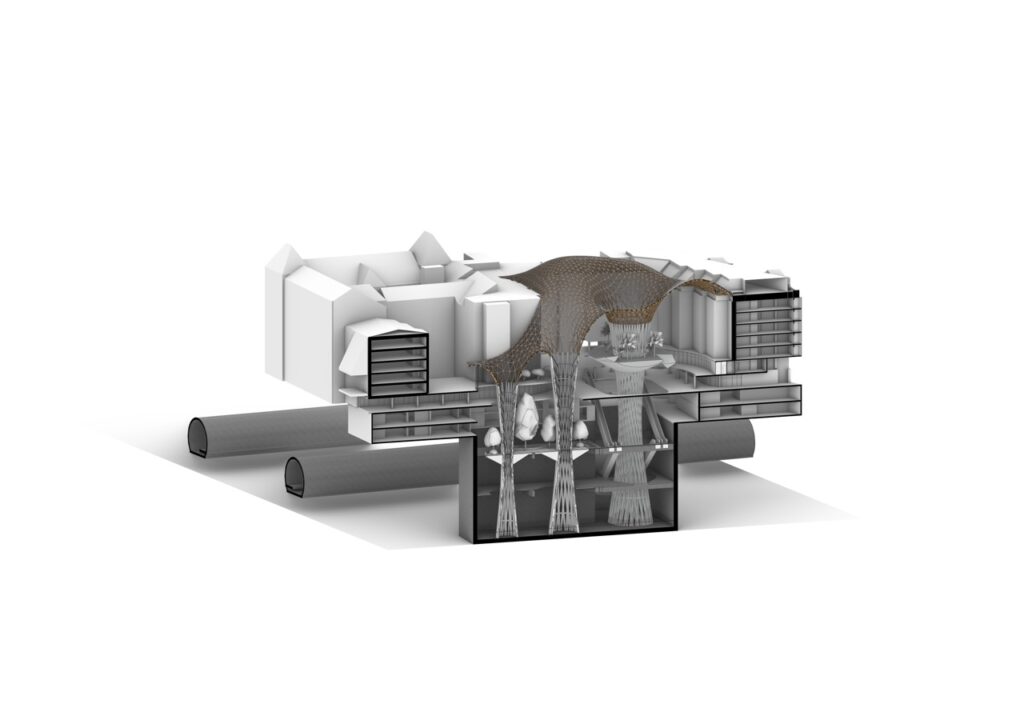
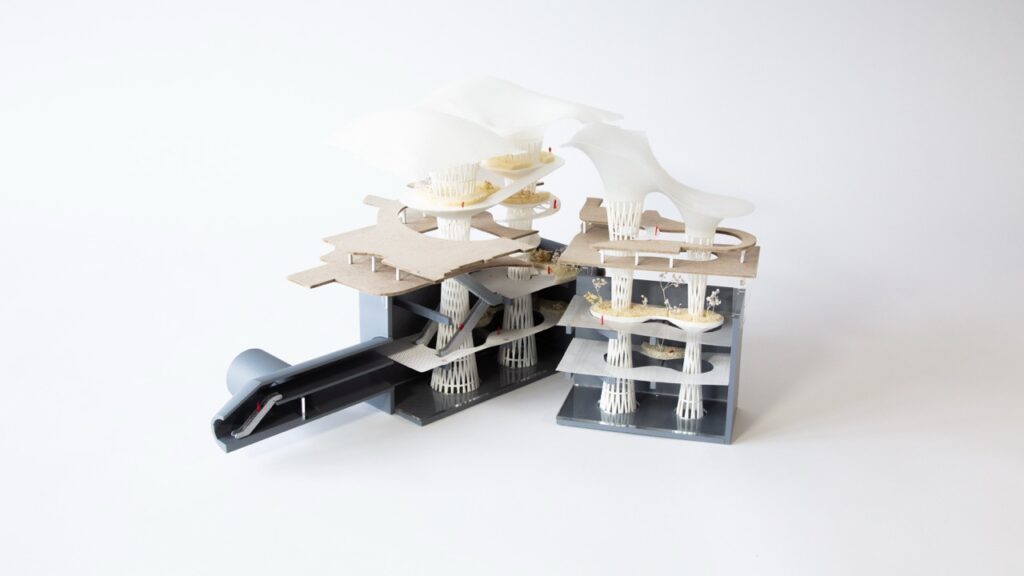
“Right next to the arcade, a building is due to be demolished – to make way for the new U5,” he explains. “So I asked myself: couldn’t we think about a demolition like this in a different way? Not just tearing it down – but deliberately transforming it into something new. Something that connects existing structures and opens up new levels.” His idea: to incorporate the underground tunnel into the design and link it underground with the shopping arcade. This creates a spatial structure that unites the underground, library, shopping arcade, nursery and cafés under a new, shared roof. 

What has come of it?

A vertical biotope!

A vertical biotope that does more than just look good. Philipp connects the planned underground station directly to the arcade – whilst simultaneously bringing fresh greenery, fresh air and a new level of use to the urban space. The biotope not only serves as a visual highlight, but also plays an active role within the building: it supports natural climate processes, regulating temperature and humidity – entirely without energy-intensive systems.
Urban_Oasis.indd
A design that demonstrates how architecture is rightly not just the ‘design of space’ but also the ‘art of building’.

A building that breathes

“Actually, my idea was to retain as much of the original passageway as possible and simply install a delicate structure in the courtyard. Perhaps a small park, to make better use of the space and bring the courtyard to life. But that wouldn’t have worked due to the distances to the neighbouring buildings. Furthermore, there was a lack of connection to the passage, but also to the underground and the surrounding facilities such as the library and the nurseries above the passage. So, in response to that, I came up with something to bring all the facilities together.”

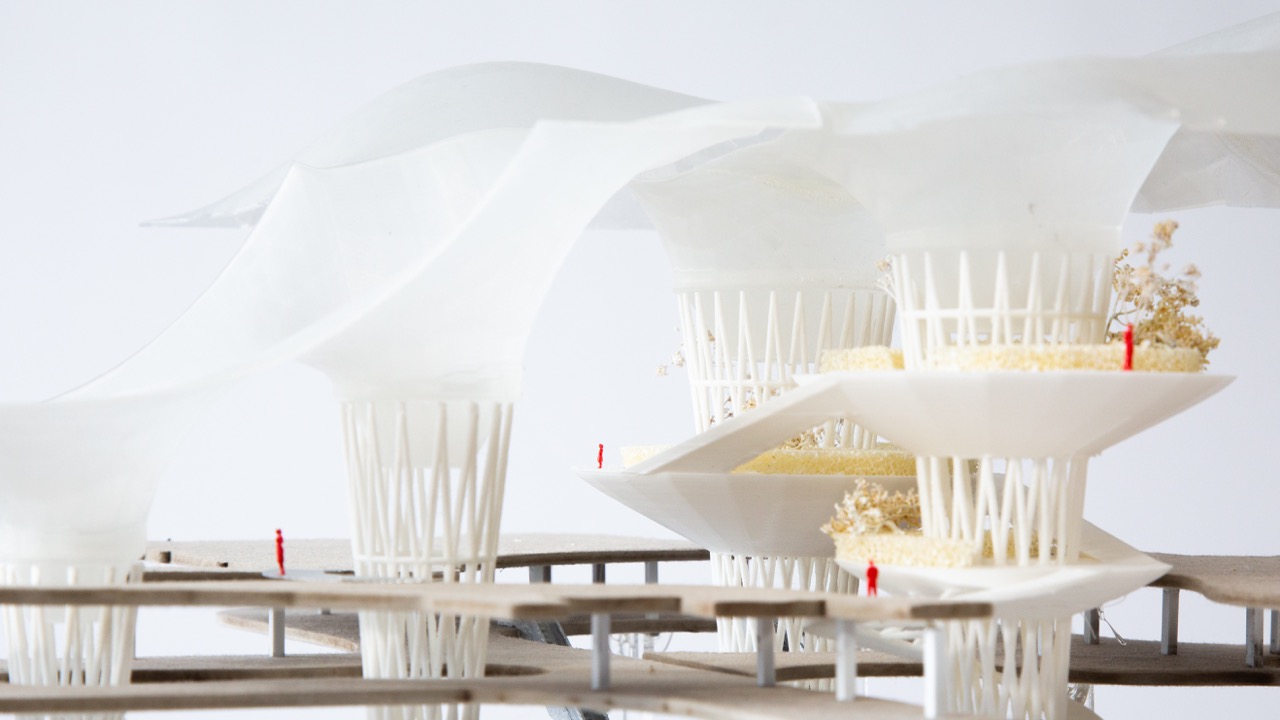
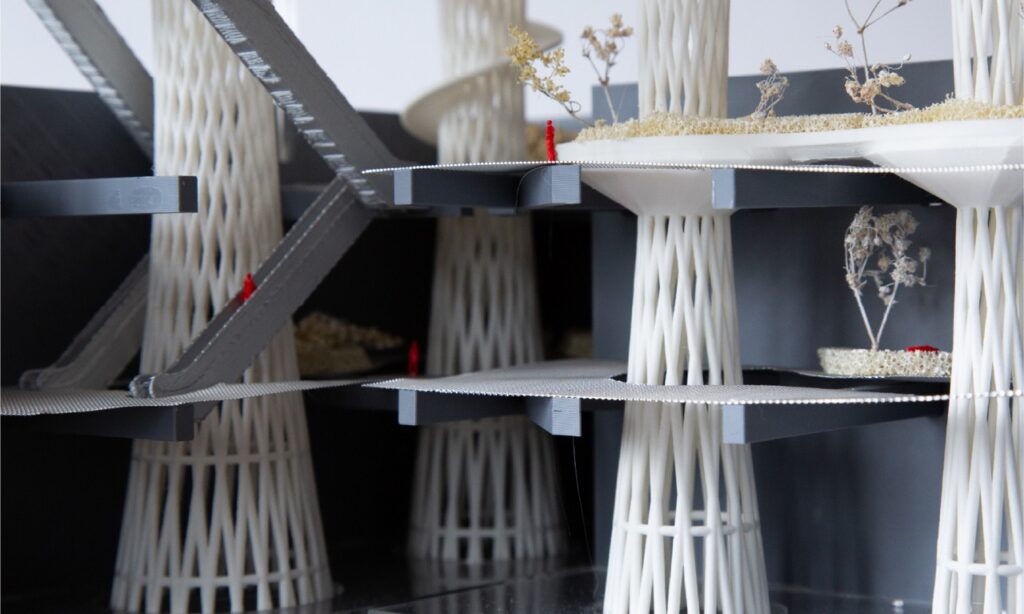
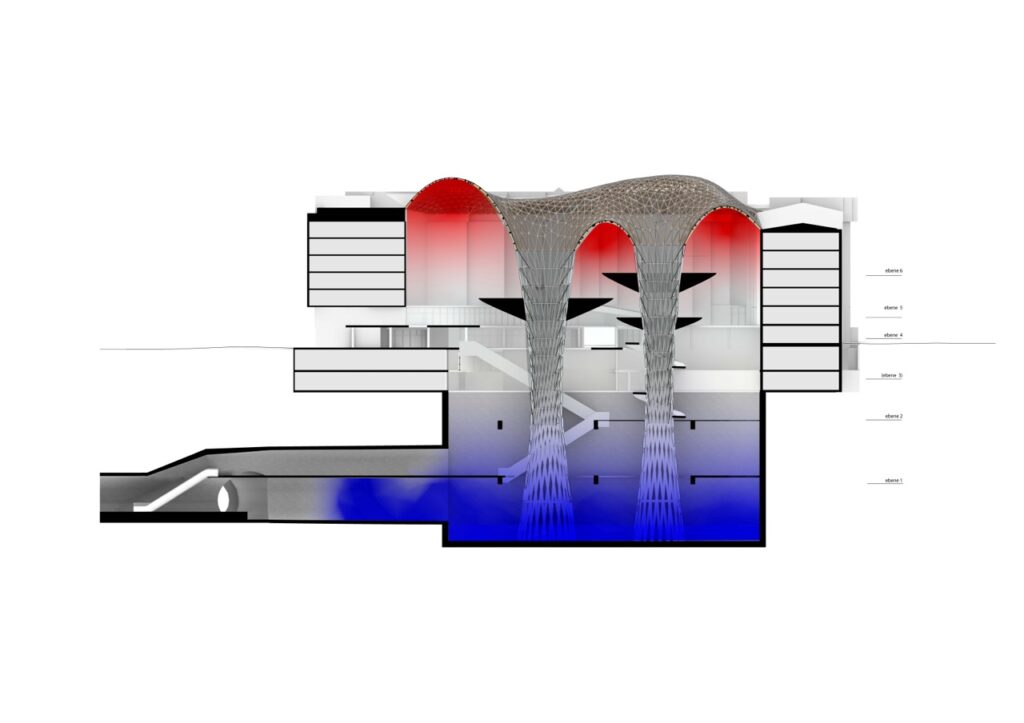
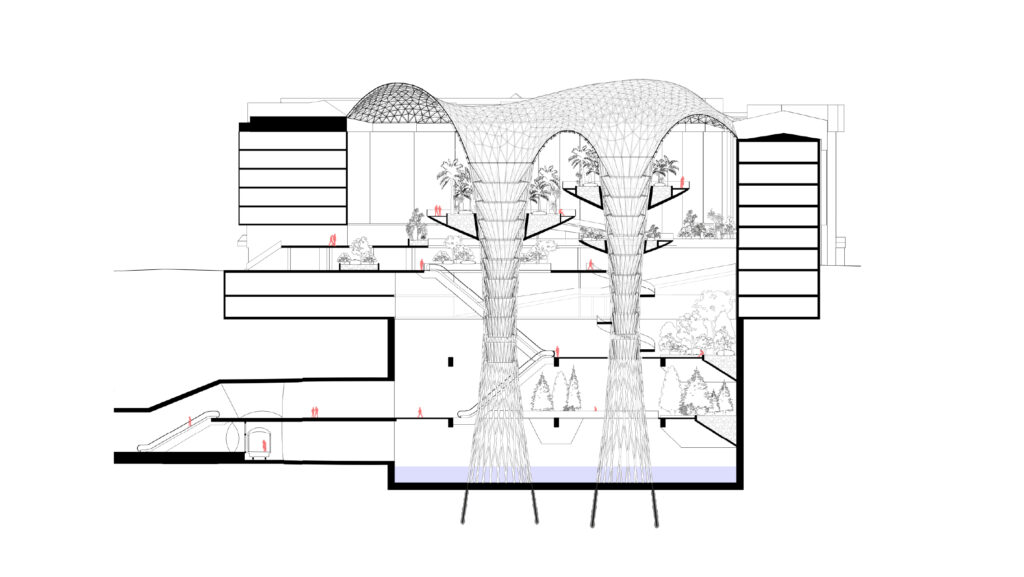
That is why Philipp first gave his model a good airing – in the truest sense of the word. In several places along the passage, he drills openings that run through all the storeys. This creates a direct connection between the underground at the very bottom and the various levels above – from the shops to the public facilities.  In these vertical shafts, he places four curved supports shaped like an hourglass. They bear the free-form climate envelope that covers the entire structure, protecting the interior and regulating the climate within, regardless of the weather outside.

The principle behind it: the so-called chimney effect. It sounds like a physics lesson, but it’s actually quite simple. Warm air rises, cold air is drawn in from below – just like in a chimney, where hot air escapes and fresh air flows in. In summer, the envelope can also be opened – via flexible side slats that resemble gills. This allows the heat to escape upwards, whilst cooler air enters from below. And in winter? Then the flaps simply stay closed, and the heat stays inside.

Climate cover

A climate cover is a transparent cover, almost like a giant bell jar. It protects whatever is underneath from wind, rain or cold and ensures that it gets warmer inside, or that the temperature fluctuates less. Incidentally, it is used particularly often for greenhouses!

Climate in layers

Nature reimagined vertically

Why should urban greenery always lie flat on the ground? Philipp thought: if we’re going to think outside the box, let’s do it properly – and in his design, he simply let the plant life grow upwards. After all, there’s far more space there than in the original, small courtyard. The result is a vertical biotope spanning five levels – with different climate zones, temperatures and atmospheres. Right at the bottom, at underground level, cyclamen bloom alongside yews. The further up you go, the more lush it becomes: shrubs, ferns, palm trees. A bit like a stroll through different continents – right in the middle of the building.


And who knows? Perhaps even endangered plant species will find a new home here. Because what Philipp has designed is more than just a building: it is a part of the city that breathes with it. A living space intended for people just as much as for nature. And perhaps also a small hint at what our buildings might look like in the future – vibrant, diverse, inviting.

Underground meets wind turbine

Philipp’s design is no pipe dream – instead, it takes things a step further precisely where the city often stops: in its interstitial spaces. The passageway, once austere and underused, becomes a hub for people and possibilities. The direct link to the underground and the opening up of the inner courtyard create new pathways and sightlines. Library and nursery, cafés and shops – all of these are brought closer together, linked by the architecture and, thanks to the lush planting, transformed into a place that invites you to linger.
Even the typical draught familiar from the underground – that brief moment when the train pulls in and the rush of air blows towards you – is not simply ignored. In Philipp’s design, this very movement becomes an integral part of the ventilation system. Pressure and suction ensure that fresh air flows through the building – without any additional technology. Anyone who thought the Vienna Underground was already sustainable – there’s still room for improvement 😉

Staying cool

Thanks to a water reservoir

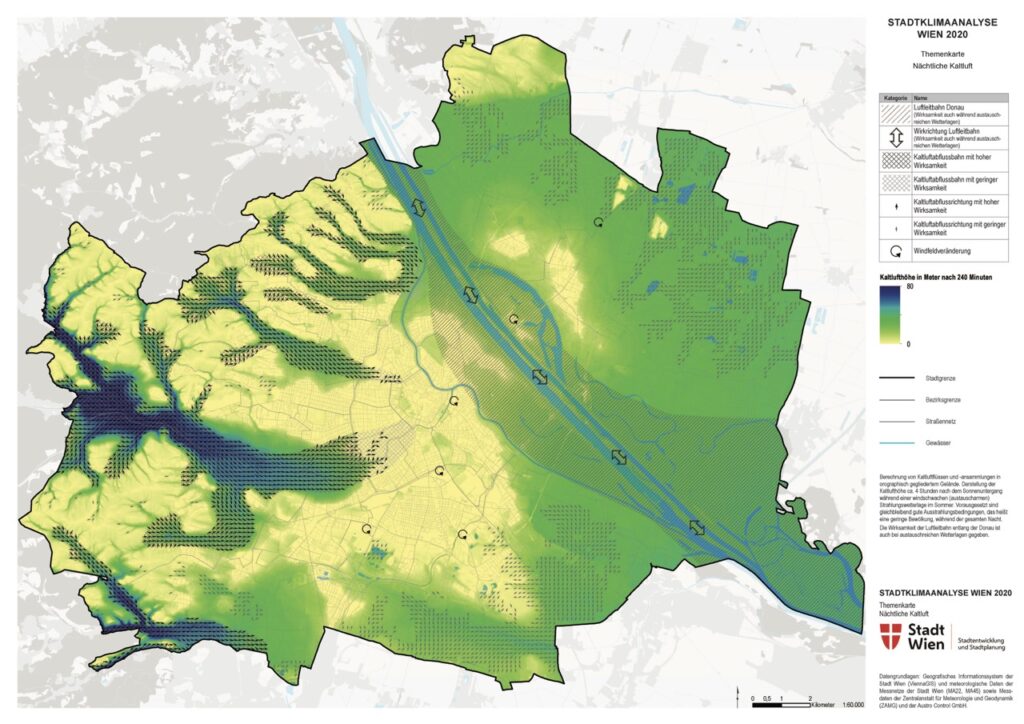
It’s true that the essentials are often invisible to the eye – because hidden beneath the building, Philipp has incorporated a 2,000 m³ reservoir that collects and stores rainwater. It also absorbs cool air from natural cold air corridors at night, thus acting as a cold storage unit for hot summer days.

Cold air corridors

Cold air corridors are practical air pathways that often form over meadows, fields, forests or bodies of water, where the air can cool down more effectively at night than in the city. The heavy, cold air then flows like water into lower-lying areas, such as streets, valleys or courtyards. In this way, they help to cool urban spaces with cool, fresh air.
But the system does not stop at the property boundary: the rainwater tank is shared with neighbours, so that the surrounding area also benefits from the infrastructure. The water can either be used to water flowers, or it can be filtered for drinking or washing. This makes the building a sustainable and generous neighbour.

Architecture that takes responsibility

Philipp’s design shows that architecture, when conceived intelligently and, above all, holistically, connects things that would otherwise run parallel to one another: technology and the environment, infrastructure and everyday life, the city and nature.


What began as a quiet shopping arcade becomes a living organism – a building project in which buildings, infrastructure, nature, energy and water work together rather than against one another.


And perhaps that is the most exciting idea of all: that good architecture does not have to reinvent everything. Instead, it simply requires looking closely – at what is there, at what it could become, and at how to bring the various elements into harmony with one another.

Can't get enough of our Blog?

Keep reading here:

Interfaces You Can’t Program

Few people know better than Stefan Plainer that there’s more beneath Austria’s construction sites than just soil. As the CEO and founder of EOD Munitions Clearance, he has spent many years working where construction projects meet history—and, in case of doubt, unexploded ordnance.
Weiterlesen »

You don’t skimp on Tools

Digitization on a Small Budget A Practical Experience Report Complex, expensive, and far removed from day-to-day work—unfortunately, at first glance, digitization is a topic that
Weiterlesen »

From Data Dreams to Reality

Many performance specifications require digital systems for evaluation, monitoring, and documentation. We show you how to recognize what’s really meant—and which solution is the right fit.
Weiterlesen »

The eye thinks too

When we started developing our first visualisations, the goal was clear: to make construction sites more vivid, data more tangible, and decisions easier. What began as a simple point overlay on a digital map has since become a powerful tool. A tool that not only shows what was – but helps to understand what is happening, why it is happening, and what this might mean for the rest of the construction process.

Weiterlesen »

A PICTURE IS WORTH A THOUSAND EXCEL SPREADSHEETS

In the beginning was the word. And that word was: “visualisation”. It was supposedly uttered by Philipp, Bernhard and Florian when they set up eguana in 2015. Just how much has changed over the past 10 years – and what the future still has in store for us – is demonstrated today by our “visualisation expert” Philipp Eder.

Weiterlesen »