



HOW BIG IS YOUR CAKE?
In many construction projects, data management starts pragmatically: a few measuring points, a few sensors, a spreadsheet. As long as everything remains manageable, Excel and similar tools work surprisingly well. Sometimes, low-tech is exactly what you need.
Just like baking a cake: my oven works wonderfully as long as I’m only supplying my family with baked goods. One cake at a time, rarely more than one a day.
But no one would think of using a household oven to supply the café around the corner—or even a supermarket—with baked goods. At some point, the equipment simply isn’t enough. What initially seemed charming suddenly becomes a problem.
The same goes for data management.
AS THE PROJECT GROWS, SO DO THE DEMANDS
With every additional measuring point, every new construction phase, and every extra requirement, complexity grows. What was manageable yesterday suddenly becomes a burden, and problems start to emerge—not immediately, but they build up until they overwhelm you.
Hold your breath—we’re going to throw in one of those dreaded buzzwords: “scalability.” Because it’s precisely this scalability that often spells the downfall of an otherwise good solution in the medium term.
At its core, scalability describes a system’s ability to grow—not just in terms of data volume, but also in handling more measuring points, more participants, and more evaluations. And ideally, all of this without additional headaches, chaos, or Excel monsters. Scalability is the ability of a system to grow alongside increasing data volumes, project sizes, and demands—without processes becoming unstable or unwieldy.
This becomes particularly evident in special foundation engineering, such as injection work or jet grouting (DSV) combined with structural monitoring. Here, large amounts of measurement data are generated—pressure, volume, heave/settlement/displacement, and much more. This data isn’t just for documentation; it’s the central foundation for quality assurance and decision-making.
Without the right tools, data management quickly faces one of three “too” problems:
Too much—when the data volume overwhelms the system
In small projects, such data can still be evaluated manually. But as soon as multiple manufacturing processes run in parallel or different devices are used, a data stream emerges that can no longer be managed sensibly by hand.
Too diverse—when data doesn’t come together
Scalability also affects the comparability of data when it no longer comes from a single source. Measurement values from different construction phases, devices, or time periods must be evaluated uniformly. Without a central database, isolated solutions, parallel files, and contradictory results emerge—and that’s not a solid basis for decision-making.
Too slow—when decisions can’t wait
Another aspect is responsiveness. When limit values are exceeded or deviations occur, the system must be able to react—ideally automatically. This requires data to not only be stored but continuously evaluated. And not next week, but in real time!
Many projects attempt to meet these requirements with in-house developments or generic IoT platforms. Technically, this is possible, but organizationally, it’s often complex. Configuration, maintenance, and adaptation take time, while construction-specific logic is frequently lacking.
Specialized industry software like eguana SCALES is designed precisely for this kind of scaling. It processes large amounts of data automatically, provides a shared database, and enables continuous evaluation and transparent documentation—regardless of project size or data volume, and, most importantly, tailored to the respective process.
The advantage lies not only in individual functions but in stable processes. Whether there are ten or a thousand measuring points, the way data is collected, evaluated, and documented remains consistent. This creates security, clarity, and trust in the data.
Additionally, SCALES offers domain-specific logic—a structure that understands which data belongs together, how it must be interpreted, and what significance it holds in the project context. Without this layer, there’s a lot of data and technology—but little orientation and no meaningful scalability.
Scalability isn't a luxury — it's a prerequisite
When planning a construction project today, it’s often unclear how data volumes will evolve. Requirements change. Participants come and go. The art lies in choosing a system that doesn’t just survive the first few months but accompanies the project to the very end.
Scalability isn’t a feature—it’s the foundation. A good system isn’t judged by how it performs today but by how it adapts to new conditions tomorrow. Without extra effort, without data loss, and ideally without compromises.
Conclusion: Thinking Ahead Pays Off
If you already know today that your project will grow larger, more complex, or more critical tomorrow, you should choose your digital infrastructure accordingly. Not every project needs eguana SCALES right away (though we also deliver significant value in very small projects). But when it grows—you’ll be glad you planned ahead.
And for those who are unsure about what their project truly needs—let’s talk! We’re happy to help assess what’s required. Maybe the kitchen oven is still enough. Or maybe it’s time for the professional bakery.
For those still unsure, we’ve compiled an overview of typical performance specification phrasing here, along with an interpretation of what kind of data management system they indicate.
And more on data management in performance specifications and tenders can be found here.

FROM EXCEL TO PLATFORM: WHY SCALABILITY IN CONSTRUCTION DATA MANAGEMENT IS CRUCIAL
Scalable data management in construction—from simple Excel spreadsheets to professional platform solutions. Why project size matters and how eguana SCALES grows with your project. Learn more now.

From Data Dreams to Reality
Many performance specifications require digital systems for evaluation, monitoring, and documentation. We show you how to recognize what’s really meant—and which solution is the right fit.
The eye thinks too
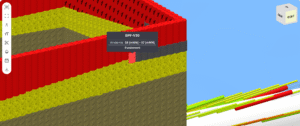
When we started developing our first visualisations, the goal was clear: to make construction sites more vivid, data more tangible, and decisions easier. What began as a simple point overlay on a digital map has since become a powerful tool. A tool that not only shows what was – but helps to understand what is happening, why it is happening, and what this might mean for the rest of the construction process.

A PICTURE IS WORTH A THOUSAND EXCEL SPREADSHEETS
In the beginning was the word. And that word was: “visualisation”. It was supposedly uttered by Philipp, Bernhard and Florian when they set up eguana in 2015. Just how much has changed over the past 10 years – and what the future still has in store for us – is demonstrated today by our “visualisation expert” Philipp Eder.

Urban Oasis
HOW A SHOPPING ARCADE BECOMES AN ECOSYSTEM How can architecture be designed to actively support the climate – without replacing existing structures, but instead making

AND EVERY DAY, THE DATA JUNGLE GREETS US
If you’re thinking of speed dating here, you’re not entirely wrong. Except that in our case, it’s not about heart-fluttering moments and life plans, but about measurement data, excavation pits and digital tools.